
The Data-Centric Operation Model
How Inter-Urban Bus Transportation Owners Can Get Instant Business Answers—Without Chasing Employee For Reports
Let’s start with a quick test. How long would it take you to answer these questions about your company?
- How much profit does each of your buses make, on average, per trip?
- Which staff are rude to passengers and causing customers to leave?
- Who are your frequent travellers who haven’t booked a trip in the last three months?
- What has your revenue growth rate been over the past three years?
- What has your average seat occupancy been for the last quarter?
If you need to call your accountant, dig through piles of paper, or simply don’t have the answer, you’re not alone. This is how most inter-urban bus companies are run today. Owners must navigate layers of staff and paperwork just to answer basic questions about their own business.
This is also the main reason so many companies run at a loss for years or fail to reach their full potential. You’re managing in the dark. With the daily volume of tickets and parcels, it’s easy to focus only on today’s takings and be completely blind to past performance or future trends.
Why does this happen? It’s because you lack an operating system that gives you centralised, clear access to your data for decision-making. Your information is trapped in different places—paper logbooks, spreadsheets, WhatsApp groups, and word-of-mouth updates. Piecing it all together is a nightmare. If you truly intend to grow profitably, you cannot afford to run your business this way.
The good news is, there is a better way. The most successful bus companies you admire use an operating model that isn’t obvious from the outside. You might think their secret is new buses or more routes, but these are just the results. Their real advantage is a hidden operating system that funnels data from every part of the business into one central place. This creates an intelligence system for decision-making. This approach is what separates the average companies from the elite.
Building a successful bus company in today’s competitive market requires investing in an operating system that gives you instant access to information. You need to centralise data from all your disparate sources to make grounded decisions. You should be able to answer any critical question about your business without chasing employees or paperwork. Your entire operation should be in the palm of your hand, accessible anytime, without you needing to be physically present at any terminal.
Is this how you want to run your company?
If so, let’s explore the Data-Centric Operation Model. This model will change how you think about managing information and its direct impact on your decisions
The Isolated Data Model vs. The Data-Centric Model
To appreciate the new model, you must recognise your current one. You are likely familiar with the Isolated Data Model. In this model, information is fragmented and scattered. Tickets are recorded in one book, parcels in another, expenses somewhere else, and customer feedback is lost in conversations. This makes informed decision-making incredibly difficult and slow. You rarely have the right information at the right time, making it impossible to plan concretely for the future. Decisions are often based on gut feeling or simply copying competitors. This way of working sets you up for average results at best.
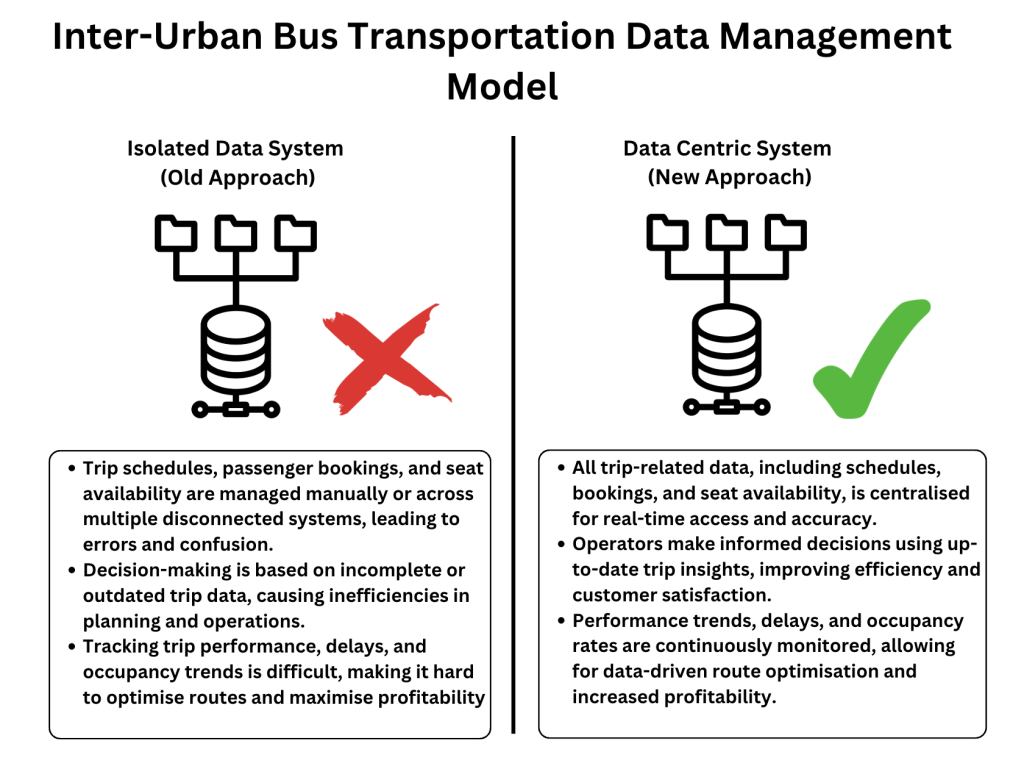
On the other hand, a Data-Centric Model ensures all data from every part of your business flows into one centralised system. Information on trips, bookings, parcels, customer complaints, and driver performance is collected in a standard, accessible format. On top of this centralised data layer, you can build an intelligence system that answers your critical business questions instantly, without relying on staff reports.
With such a system, you could comfortably answer not only the questions at the start but more complex ones like:
- Which bus generates the highest revenue but has the lowest maintenance cost?
- When is the right time to plan for selling ageing buses?
- Which specific employees are driving customers away with poor service?
- Why did ticket sales drop last month despite increased marketing?
- Are your luggage loaders at each branch generating enough revenue to justify their wages?
You’ve heard the phrase “data is the new oil.” This is what it means. You answer critical questions with certainty. Your decisions are based on facts, not feelings. You can plan expansion and investments using data-backed forecasts.
Artificial Intelligence (AI) and the Future of Your Business
We can’t talk about data without mentioning Artificial Intelligence. Forward-thinking bus companies are already using AI to outperform their competitors, and they are winning. These are the companies that first invested in a centralised data framework. They now have the clean, organised data that AI tools need to work.
AI is no longer just for large corporations. Small and mid-sized bus companies are using it to improve efficiency, decision-making, and customer experience, quickly closing the gap with bigger players. The technology is only getting better every day.
So, the question is no longer if AI is for you, but how you will use it to gain a competitive edge.
How to Get Started with a Data-Centric Framework
Now you understand why this model is essential for growth. But there’s one key truth: knowledge alone won’t change your business. If it did, every transport academic would be a successful owner.
The real difference is execution.
Results = Knowledge x Execution
Most bus owners struggle to implement this framework. It’s not a lack of intelligence. It’s because the shift requires solid IT planning, the right tools to collect data, and training your team in new processes. Going it alone is risky. You need guidance from experts who have done it before.
This is precisely why we built the Boreze Platform.
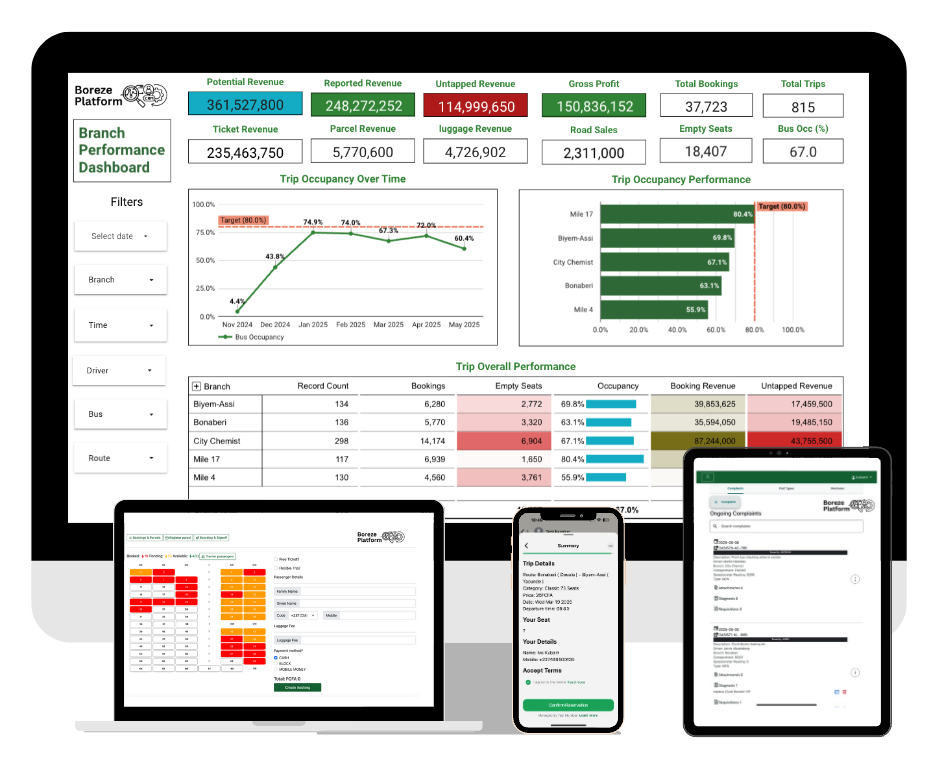
It is a complete system designed to help you manage your business with a data-centric model. Your trips, bookings, parcels, customer details, and finances are all in one platform, accessible to you 24/7. With Boreze, you can answer any business question at any time, without relying on employees or visiting a terminal.
As you grow, you deserve clarity and control. Boreze can help you get there.
This system isn’t for everyone. We work closely with inter-urban bus owners who are serious about running an efficient, transparent, and scalable business.
If that sounds like you, click HERE to book a discovery call. We will review your current information flow and decision-making process, and help you decide if the data-centric model—and Boreze—is the right next step for you
Author: Ivo Kubam
Boreze Team
21-12-2025