
Inter-Urban Bus Transportation Federated Business Units Framework
How to Provide Autonomy To Each Service While Still Keeping Full Control
If you’ve been in the interurban bus business for a while, you know that as your business expands, management gets harder.
Your core services—passenger trips and parcel logistics—are growing. But with that growth comes more transactions, more complexity, and less control from your seat.
From the outside, it might look like business is moving. But on the inside, operational efficiency is slipping. Money is leaking from employee theft, pilferage, lost customers, and poor service.
Here’s the tough part: the drop in efficiency is like a slow disease. You won’t see it early on. You might only realise it years later when you discover you’ve been running at a loss.
How you organise and manage your business as it grows is critical. The structure that worked in Year 1—where everything is managed as one unit—won’t work in Year 5 or Year 7. Growth requires a different approach.
The truth is, restructuring isn’t easy. It takes expertise and careful change management. Most interurban bus companies still use the classic unitary model, where all services are run as one block. That has its place early on, but as you scale, there are better ways to organize.
Let me introduce you to the federated business unit framework—a system that gives each service some independence while keeping everything connected. This model is borrowed from successful companies across industries that have scaled to billions in revenue, added new services, and expanded to new locations—all while keeping operations smooth.
Unitary vs. Federated Business Units
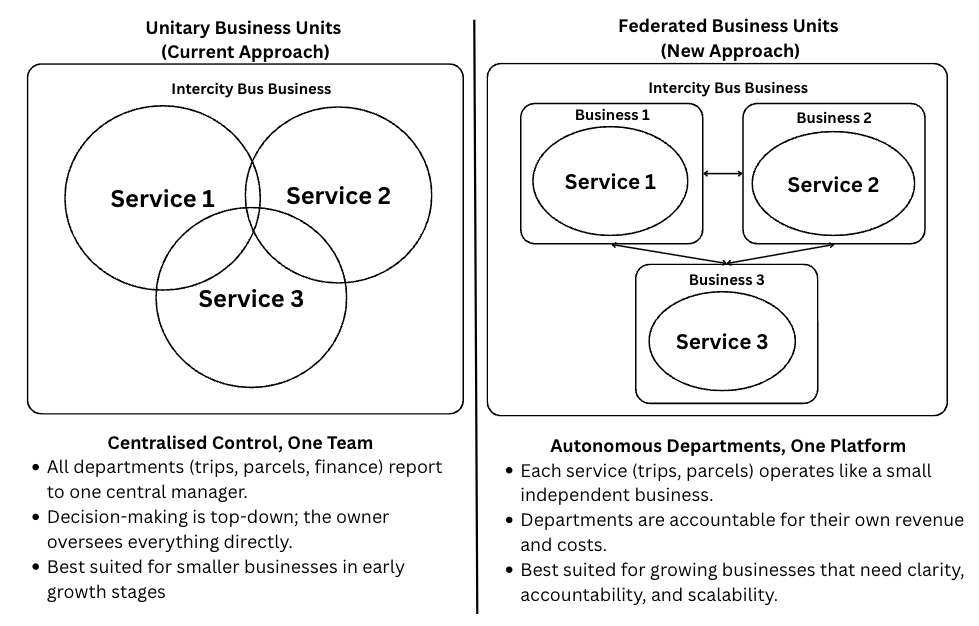
When you started, the unitary system made sense. You wanted full control and visibility as you learned the business. Keeping trips and mail services tightly linked was the right move.
But as you grow, this model becomes difficult. The business is bigger, with more moving parts. While you don’t want things to become loose, giving each service some autonomy can actually strengthen your control.
The federated system works well when you’re scaling. Here, each service operates almost like its own small company. This makes it easier to track profitability, hold teams accountable, and understand exactly how each part of your business is performing.
Let’s make this practical.
Take your two main services: trips and mail. It’s easy to assume that since mail travels on your buses, the cost of transporting it is zero. You might only look at mail revenue and think it’s profitable.
But that’s a dangerous assumption. In reality, you should account for the cost of transporting that mail as if you were using an external courier. That cost becomes revenue for your trips department. When you separate the two, you see the real financial picture—what’s truly profitable and what isn’t.
The federated model isn’t as common in our industry as the unitary one. Both have their place at different stages of growth.
How to Get Started with the Federated System
Now that you understand why a federated structure can help as you grow, there’s one thing you should know: knowledge alone won’t change your business.
If it did, every transportation professor would be a successful bus owner. But they’re not.
The real difference is execution.
Results = Knowledge × Execution
In my experience, most bus owners struggle to implement this kind of organizational change. It’s not because they lack intelligence. It’s because shifting to a federated system is strategic, requires change management expertise, can mean restructuring your team, and is risky to do alone.
That’s why we built the Boreze Platform.
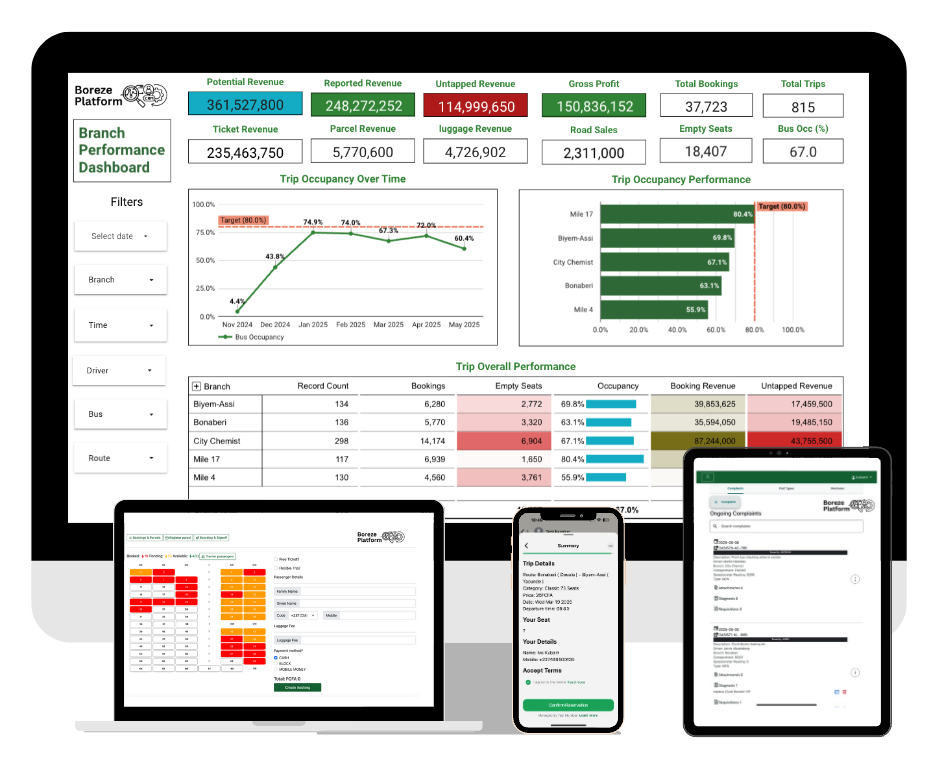
It’s a complete system designed to help you manage your business in federated units. Each service—trips, mail, finance—can be managed independently, but they’re still connected in one platform. You keep overall control, while each department runs its own day-to-day operations.
As you grow, you deserve clarity and accountability. Boreze can help you get there.
This system isn’t for everyone. We work closely with interurban bus owners who are serious about running an efficient, transparent, and scalable business.
If that sounds like you, click HERE to book a discovery call. We’ll look at your current management setup, review your services, and help you decide if the federated model—and Boreze—is the right next step for you.
Author: Ivo Kubam
Boreze Team
14-12-2025