
Operation Model: The Secret to Running Your Intercity Bus Business Without Your 24/7 Presence.
When you buy a brand-new bus for your intercity transportation business, one of the first things you look for is the vehicle manual. The manufacturer takes time to prepare it so your team knows how to get the best performance from the bus and how to manage it properly to avoid quick wear and tear. You wouldn’t accept that kind of investment without a manual, right?
Strangely, you don’t apply this same principle to your company operations. The business runs every day for years without a proper “manual” that tells employees how things should be done. Instead, the business depends heavily on the owner or a few experienced staff to keep things moving. New employees are left to “figure it out” as they go—without step-by-step guidance.
This lack of a clear operation model is one of the main reasons why bus businesses often face:
- Money leaking through loopholes you can’t trace
- Chaotic daily operations that never feel smooth
- Unhappy customers with unresolved complaints
- Constant investments that don’t grow the business
- The feeling that you must be present in every branch, every single day, for things to work properly
Running your bus business without an operations manual is like giving a driver a new bus without the vehicle manual. They might manage to drive, but don’t be surprised if the bus spends more time at the mechanic than on the road.
At Boreze, we’ve seen first-hand what happens when you put an operation model in place. Before we installed digital systems for companies like Oasis Travels and Princesse Voyages in Cameroon, we started by building their operation model. We clarified key processes, defined roles and responsibilities, and created systems that could run smoothly even without technology. Once the foundation was set, digital tools made it possible to scale operations faster—with fewer employees and more control.
If you want similar results for your business, keep reading till the end. You will learn everything you need to know creating your operation model.
Why Your Intercity Bus Business Needs an Operation Model
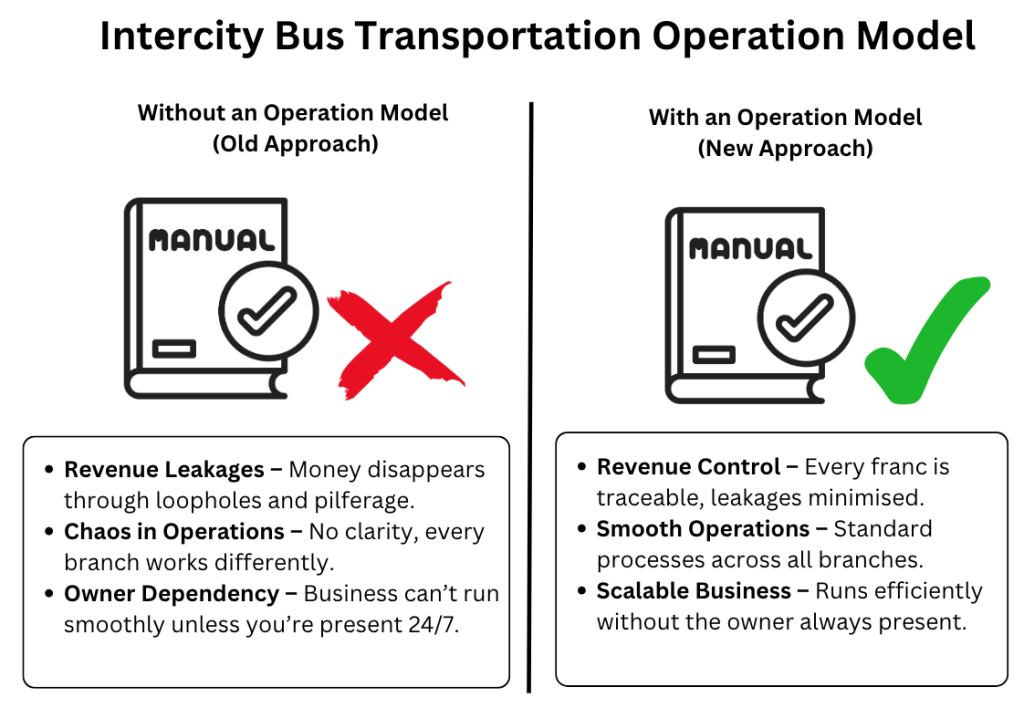
Running a bus company is hard enough. Doing it without an operation model is much harder.
Your operation model is your company’s “manual”—a living document that explains exactly how your business should run. It is unique to your company and grows with you. Unlike buses, employees, or branches, it can’t be copied by competitors. This is your hidden advantage.
A good operation model covers:
- Standard Operating Procedures (SOPs)
Step-by-step instructions for every key process—ticketing, parcels, trip planning, maintenance, expense management, and more. These SOPs ensure things are done the same way, no matter who is on duty. - Roles and Responsibilities
Each employee should know from day one what is expected of them, who they report to, and what happens if tasks are not completed. - Company Policies
Clear rules for tickets, passenger luggage, parcels, staff conduct, and more. Policies should be documented and accessible to all employees so they can act with consistency. - Documentation and Reports
Without proper records, fraud and theft thrive. Your model should define the exact reports needed, the forms to use (trip sheets, parcel logs, fuel forms, daily cash reports), when to fill them, and when they must be submitted.
How to Get Started
Building an operation model takes effort, but the sooner you start, the faster you’ll see results. You may have years of experience running your company, but putting that into a structured manual can be challenging. That’s why many owners work with transport innovation engineers who know the industry and can design a tailored operation model that truly works.
Remember: Knowledge alone won’t transform your business.
If knowledge were enough, professors of transport and logistics would be the most successful bus operators. They aren’t. The real difference comes from execution.
Results = Knowledge (Operation Model) X Execution
The truth is, most intercity bus owners struggle with execution—not because they lack intelligence, but because trial and error is costly, risky, and time-consuming when you’re dealing with buses worth millions.
That’s exactly why we created the Transport Innovation Hub. It’s a private community for forward-thinking bus operators who want to:
- Stop revenue leakage without being in every branch 24/7
- Trace every coin without adding more overhead costs
- Access ready-to-use tools and templates from transport experts
- Learn from real case studies of bus companies already recovering millions
Ready to Take Action?
We’re currently accepting a limited number of qualified bus operators this month.
Apply here to see if you qualify.